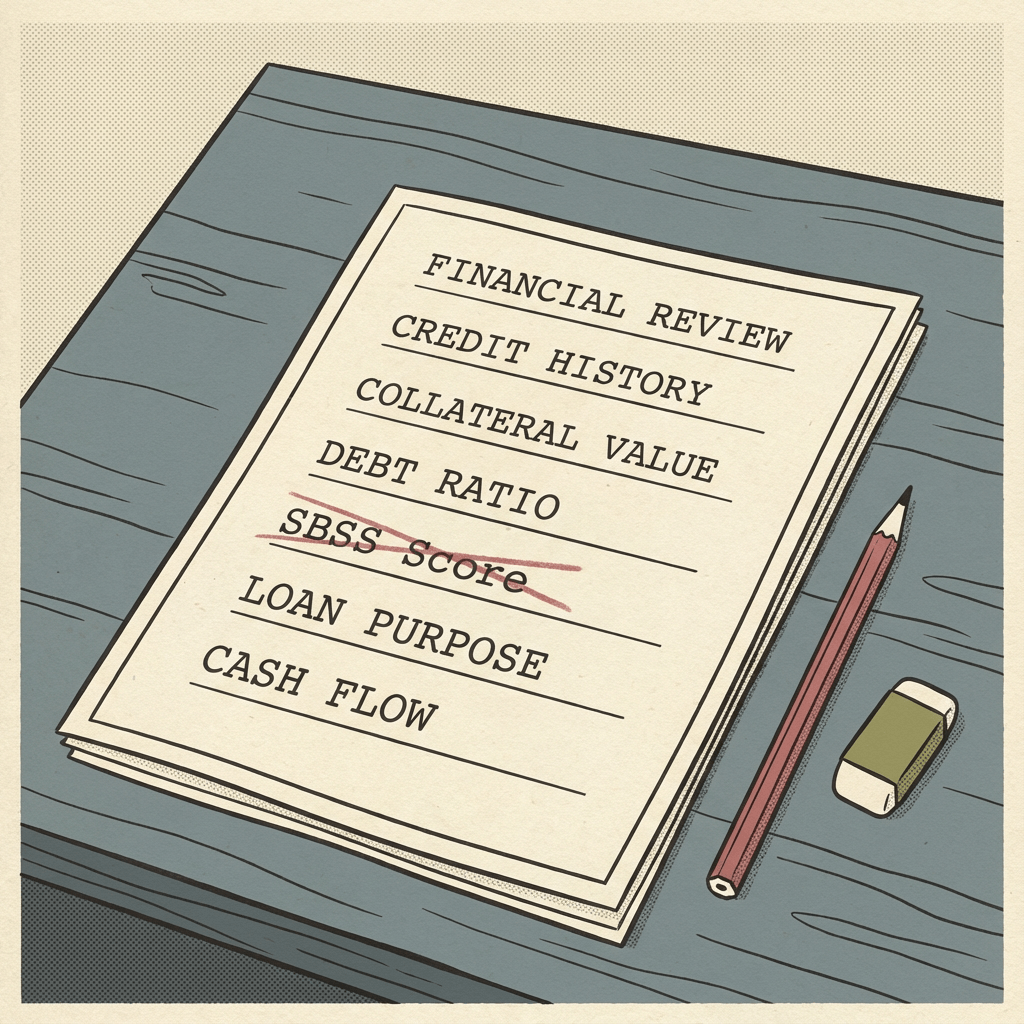
Why SBA Loans Get Denied: The 10 Most Common Reasons Small Businesses Get Rejected in 2026
- Weak credit, insufficient cash flow, and high existing debt are the most common reasons SBA loans are denied.
- Inconsistent financial documentation or unresolved tax issues can immediately stall an application.
- Applying to the right SBA lender can make the difference between approval and rejection.
Many business owners assume that if they meet the basic criteria for an SBA loan, approval is likely. In reality, a large percentage of SBA loan applications are declined before they ever reach final underwriting.
The Small Business Administration guarantees a portion of loans issued by lenders, but the decision to approve an applicant is still made by the lender. That means banks apply strict underwriting standards to ensure the loan can realistically be repaid, and these standards are unique to each lender.
Understanding the most common reasons SBA loans are denied can help business owners prepare a stronger application and avoid costly delays.
Below are the top reasons SBA loan applications fail, and what you can do to improve your chances of approval.
1. Weak Personal Credit History
Your personal credit score is the first thing a lender looks at, and for many applicants, it's where the process ends.
Personal credit remains one of the most heavily weighted factors in SBA lending. Most lenders prefer borrowers with a credit score of 670 or higher, though stronger approvals consistently happen above 680. But the score itself is only part of the picture. Lenders pull a full credit report and look at how you've managed debt over time.
Applications are commonly declined because of:
- Late payments or collections on personal accounts
- High credit utilization (especially above 30%)
- Recent bankruptcies or foreclosures
- Tax liens or civil judgments
- Too many recent credit inquiries
Because SBA loans require a personal guarantee, lenders want to see that the business owner has a demonstrated track record of responsible credit management. A borderline credit score combined with even one of the red flags above can push an application into denial territory.
The Facts: Your personal credit isn't just a number, it's a signal to lenders about how you handle financial obligations when things get tight. They take it personally because the guarantee makes it personal.
How to fix this before you apply:
- Pull your personal credit reports from all three bureaus and dispute any inaccuracies
- Pay down revolving balances to get utilization below 30% (below 20% is ideal)
- Avoid opening new credit accounts or making large purchases in the months leading up to your application
- If you have collections, negotiate pay-for-delete agreements where possible
- Check your SBA Eligibility Score through SBAScore.com before applying so you know where you stand
2. Insufficient Cash Flow
Profitability and cash flow are not the same thing, and lenders know the difference.
Even profitable businesses can be denied if they cannot demonstrate enough cash flow to comfortably support loan payments. A business might show net income on a tax return, but if the actual cash moving through the account doesn't support an additional monthly obligation, lenders will pass.
Lenders evaluate something called the Debt Service Coverage Ratio (DSCR). This measures whether the business generates enough income after expenses to cover all existing debt obligations plus the proposed new loan payment. Most SBA lenders want to see a DSCR of at least 1.25x, meaning the business generates $1.25 in available cash flow for every $1.00 in total debt payments.
Businesses often run into problems when:
- Revenue is inconsistent or seasonal without a clear pattern
- Profit margins are too thin to absorb a new monthly payment
- Existing debt obligations are high, particularly from merchant cash advances or short-term loans
- Owner draws or distributions are eating into cash reserves
- The business relies heavily on a small number of clients
Lenders will typically review 12 months of recent bank statements alongside your tax returns. If the bank statements tell a different story than the financials, that inconsistency alone can stall or kill an application.
The Facts: A business can be profitable on paper and still get denied. Lenders aren't looking at what you earned last year, they're calculating whether you can cover your current obligations and a new loan payment at the same time, every month.
How to fix this before you apply:
- Calculate your own DSCR before applying: divide your net operating income by your total annual debt payments (including the projected new loan payment)
- If your DSCR is below 1.25x, work on reducing existing debt or increasing margins before submitting
- Clean up owner draws, excessive distributions signal risk
- If revenue is seasonal, prepare a written explanation with supporting documentation showing year-over-year consistency
- Make sure your bank statements align with the revenue and expenses on your tax returns and financial statements
3. Too Much Existing Debt
If your business is already stretched thin with debt, adding an SBA loan to the stack won't make the math work, and lenders can see that immediately.
Many SBA loan applications are declined because the business already carries too much leverage. Lenders will look closely at every existing obligation, including:
- Merchant cash advances (MCAs)
- High-interest short-term loans
- Equipment financing obligations
- Existing lines of credit or credit card balances
- Revenue-based financing agreements
Businesses with multiple high-cost financing products may struggle to qualify because lenders worry the company is already overextended financially. This is especially true for companies that have stacked MCAs or taken on several short-term products to manage cash flow gaps.
This problem got significantly worse after April 2025. As part of a series of SBA rule changes, the SBA eliminated the ability to use SBA loan proceeds to pay off merchant cash advance debt. Previously, borrowers could use an SBA loan to refinance and consolidate MCA balances, effectively replacing expensive daily or weekly payments with a lower-cost, long-term SBA loan. That option is now closed.
Because MCA debt can no longer be refinanced through an SBA loan, those payments now factor directly into underwriting. If your business is carrying $5,000 or more per month in MCA payments, that obligation stays on the books during the SBA evaluation, reducing your available cash flow and DSCR. For many applicants, this is the factor that tips the math from approval to denial.
The Facts: Lenders don't just look at whether you can afford the new loan. They look at everything you already owe. If your business is servicing multiple high-cost products, the SBA loan payment becomes one obligation too many, and now that MCA debt can't be rolled into the deal, it hits your numbers even harder.
How to fix this before you apply:
- Get a clear picture of your total monthly debt obligations across all products
- Pay down or pay off short-term, high-interest obligations before applying, especially MCAs
- If you're carrying MCA debt you can't eliminate before applying, explore reverse consolidation options to restructure those payments
- Avoid taking on new debt in the months leading up to your SBA application
- Prepare a complete and accurate business debt schedule, lenders will verify it, and missing obligations will create trust issues
4. Incomplete or Inconsistent Documentation
SBA underwriting runs on documentation. If it's missing, messy, or contradictory, your application stalls, or gets declined outright.
SBA loans require more documentation than most other business financing products. This is one of the tradeoffs for getting access to lower rates and longer terms. Lenders need to verify your financial picture from multiple angles, and every piece of the puzzle matters.
Common required documents include:
- Two to three years of business tax returns
- Personal tax returns for all owners with 20% or more ownership
- Year-to-date profit and loss statements
- Year-to-date balance sheet
- Business debt schedule (every obligation, every balance, every payment)
- Business bank statements (typically 3 to 12 months)
- Business licenses and formation documents
Where applications fall apart isn't usually one missing document. It's inconsistencies between documents. If your tax return shows $800,000 in revenue but your bank statements show $600,000 in deposits, that's a red flag. If your P&L shows $50,000 in net income but your tax return shows a loss after deductions, that requires explanation.
Lenders also flag applications where financial statements appear to be created after the fact, hastily assembled numbers that don't tie to the bank activity or tax records. This signals either poor financial management or an attempt to present a better picture than reality.
The Facts: Lenders aren't just checking boxes when they request documentation. They're cross-referencing every number against every other number. One inconsistency forces them to question everything else in the file.
How to fix this before you apply:
- Assemble all required documents before starting the application, not during the process
- Reconcile your tax returns, bank statements, and financial statements to make sure the numbers align
- If there are legitimate discrepancies (cash vs. accrual accounting, large one-time transactions), prepare a written explanation in advance
- Work with your CPA or accountant to ensure year-to-date financials are accurate and current
- Don't guess or estimate on the debt schedule, list every obligation with exact balances and payment amounts
5. Limited Time in Business
Two years in business is the minimum for an SBA 7(a) working capital loan.
This isn't an SBA rule per se, it's a lender-level risk threshold. Two years of operating history gives underwriters enough data to evaluate trends, cash flow patterns, and the owner's ability to manage the business through different conditions.
Startups and companies with limited operating history face higher risk from a lender's perspective. Revenue is less predictable. Expenses are harder to forecast. And there's less evidence that the business model actually works at scale.
That said, startup SBA financing does exist. But it typically requires:
- Strong and directly relevant industry experience for the applicant
- Significant collateral to offset the lack of operating history
- Higher owner equity contributions (often 20% or more of the total project cost)
- Detailed and credible financial projections
- A well-documented business plan
Franchises sometimes have an easier path here because the franchise model itself has a track record, even if the specific location is new. But even then, lenders want to see that the owner has relevant experience and enough skin in the game.
The Facts: Time in business isn't just about age, it's about having enough financial history for a lender to evaluate. A two-year-old business with clean books and consistent revenue is a much easier underwrite than a five-year-old business with messy records and unpredictable cash flow.
How to fix this before you apply:
- If you're under two years, make sure every other part of your application is as strong as possible, credit, cash flow, collateral, and documentation
- Prepare a thorough business plan with realistic, defensible financial projections
- Highlight relevant industry experience, certifications, and management track record
- Be prepared to put more equity into the deal to offset the perceived risk
- Consider waiting until you've crossed the two-year mark if your financials are still building
6. Insufficient Collateral
SBA loans are partially guaranteed by the government, but that doesn't mean lenders aren't looking for collateral to back the deal. The SBA allows banks to secure any and all available collateral.
While SBA loans are government-backed, lenders still prefer to secure loans with collateral whenever possible. The SBA guarantee reduces the lender's loss if the loan defaults, but it doesn't eliminate it entirely. Collateral provides an additional layer of security that can make the difference between an approval and a decline, especially for larger loan amounts.
Collateral may include:
- Commercial real estate
- Business equipment and machinery
- Inventory
- Accounts receivable
- Personal real estate (including primary residence)
- Other personal assets
As of April 2025, the SBA expanded collateral documentation requirements to smaller loan sizes. Lenders are now required to more formally document collateral shortfalls instead of relying primarily on cash flow for justification. This means even for loans that were previously considered low-risk, lenders need to show they've evaluated the borrower's available collateral and documented any gaps.
If the borrower cannot demonstrate sufficient collateral or personal net worth, the lender may decline the loan, or at minimum, require additional conditions to be met before approval.
The Facts: The SBA guarantee doesn't replace collateral, it supplements it. Lenders still want to see that you have assets backing the loan, and the collateral bar got higher in 2025.
How to fix this before you apply:
- Inventory all available business and personal assets before applying
- Understand your personal net worth and be prepared to pledge personal assets if needed
- If you own real estate, get a current estimate of market value and outstanding mortgage balance
- For equipment-heavy businesses, maintain accurate asset lists with estimated values
- If collateral is thin, strengthen other areas of the application, cash flow, credit, and time in business, to compensate
7. Tax Issues or Unpaid Liabilities
Outstanding tax problems can derail an SBA loan application faster than almost any other issue.
Tax compliance is a hard requirement in SBA lending. Lenders run IRS verification checks during underwriting, and any unresolved tax issues will surface. This isn't a gray area, if you owe the IRS or have unfiled returns, the application is going to hit a wall.
Common red flags include:
- Unpaid IRS tax balances (personal or business)
- Payroll tax delinquencies
- Missing or unfiled tax returns for any required year
- State tax liens or outstanding state tax obligations
- Tax returns that were filed but show balance-due amounts that haven't been paid
Lenders typically require tax obligations to be fully resolved or placed on a formal IRS payment plan with a history of on-time payments before approving financing. In some cases, applicants with active payment plans can still qualify, but only if the payments are current and the plan is well-documented.
It's worth noting that FastWaySBA works with lenders that have programs designed for business owners who owe taxes, provided the right conditions are met. Not every tax issue is a permanent disqualification, but it has to be addressed proactively.
The Facts: The IRS check isn't optional and it isn't something you can explain away. If you owe taxes, fix it before you apply. A payment plan in good standing is workable. An unresolved balance or missing return is not.
How to fix this before you apply:
- File all outstanding personal and business tax returns immediately, even if you owe money, filing is the first step
- If you have an unpaid IRS balance, set up a formal installment agreement and make several on-time payments before applying
- Resolve any state tax issues as well, lenders check those too
- Get a current IRS tax transcript to verify your standing before the lender does
- If you're unsure about your tax status, consult a CPA or tax attorney before starting the application process
8. Declining Revenue or Financial Instability
Even if your business was profitable last year, lenders are focused on the direction you're heading, and downward trends raise serious concerns.
Businesses experiencing recent financial instability may struggle to qualify for SBA financing. Underwriters don't just look at snapshots. They evaluate trends across your most recent tax returns and financial statements to determine whether the business is growing, stable, or declining.
Lenders evaluate patterns such as:
- Year-over-year revenue declines
- Shrinking profit margins
- Periods of negative cash flow
- Increasing reliance on short-term financing to cover operations
- Loss of major clients or contracts
Even if a company was historically profitable, lenders may hesitate if the business appears to be moving in the wrong direction financially. A business that did $2 million in revenue two years ago but dropped to $1.5 million last year and is trending at $1.2 million this year tells a story that makes underwriters uncomfortable, regardless of what caused the decline.
That said, not every loss is a dealbreaker. If your business is showing losses on the tax return due to depreciation, one-time expenses, or aggressive write-offs, but the underlying cash flow is healthy, there may still be a path to approval. The key is being able to document and explain what's behind the numbers.
The Facts: Lenders underwrite the trend, not just the number. A business making $500K with upward momentum is a better risk than a business making $1M on a downward slide.
How to fix this before you apply:
- Review your last two to three years of tax returns and identify any declining trends before a lender does
- If revenue dipped due to a specific, explainable event (lost a contract, COVID hangover, market shift), prepare a written narrative explaining the cause and the recovery plan
- Show year-to-date financials that demonstrate a rebound or stabilization
- If losses on the return are driven by non-cash deductions like depreciation, prepare an addback analysis that shows true cash flow
- If the decline is ongoing, consider whether now is the right time to apply or whether stabilizing first gives you a stronger shot
9. Industry Risk
Some industries face tighter scrutiny from SBA lenders, not because approval is impossible, but because the underwriting bar is higher.
Certain industries carry higher statistical failure rates or are subject to volatility that makes lenders more cautious. This doesn't mean SBA financing is off the table for these sectors, but it does mean lenders may require stronger financial performance, additional collateral, or more extensive documentation to get comfortable.
Industries that commonly face additional scrutiny include:
- Restaurants and food service
- Hospitality and hotels
- Construction (especially startups)
- Seasonal businesses with significant revenue swings
- Highly cyclical industries tied to economic conditions
- Cannabis-adjacent businesses
- Businesses with regulatory risk exposure
What matters more than the industry label is how your specific business performs within that industry. A restaurant with five years of consistent profitability and strong cash flow is a very different underwrite than a restaurant that opened last year. Lenders are evaluating your deal, not your industry in isolation.
The real issue is when industry risk stacks on top of other marginal factors. If your credit is borderline, your cash flow is tight, and you're in a high-risk industry, the combination makes approval difficult. But if the rest of the application is strong, industry alone usually isn't a dealbreaker.
The Facts: Lenders don't blacklist industries, they adjust the bar. If your business is in a sector that gets extra scrutiny, everything else in your application needs to be that much tighter.
How to fix this before you apply:
- Know that your industry may face additional questions and prepare accordingly
- Highlight long operating history, consistent revenue, and customer diversification
- Provide industry context that shows your business outperforms sector averages
- Be proactive about explaining seasonal patterns or cyclical dips with historical data
- Work with a lending partner that has experience in your specific industry, not every lender underwrites every sector the same way
10. Applying to the Wrong Lender
One of the most overlooked reasons SBA loans get denied has nothing to do with the borrower, it's applying to a lender that was never going to say yes to that deal in the first place.
Different banks have different risk tolerances, industry preferences, loan size sweet spots, and internal underwriting criteria. A loan declined by one lender may be approved by another that specializes in the borrower's sector or has more flexibility on certain factors. This is one of the most common, and most avoidable, mistakes in SBA lending.
When a business owner walks into their local bank and applies for an SBA loan, they're submitting to one lender's underwriting criteria. If that bank doesn't do many SBA loans, doesn't specialize in the borrower's industry, or has internal policies that make the deal a poor fit, the result is a decline, often without the borrower understanding why. They walk away thinking they don't qualify for an SBA loan, when in reality they just applied to the wrong place.
This problem is even more common now that SBA underwriting requirements have tightened. With the 2025 rule changes, including higher credit thresholds, expanded collateral requirements, and the elimination of MCA refinancing, the differences between lenders matter more than ever. Some lenders have adapted quickly. Others are still catching up. And the gap between a lender who knows how to structure a deal under the new rules and one that doesn't can be the difference between getting funded and getting declined.
This is exactly why FastWaySBA exists. Instead of submitting to one bank and hoping for the best, FastWaySBA pre-qualifies applicants across a network of top SBA lenders before a formal application is ever submitted. That means the deal is matched to the lender most likely to approve it, based on credit profile, cash flow, industry, loan size, and the specifics of the deal structure.
This process catches potential issues early, when there's still time to fix them. Instead of finding out about a problem through a decline letter three weeks into underwriting, FastWaySBA identifies red flags upfront and helps borrowers address them before they ever hit a lender's desk. It's the difference between self-underwriting and hoping it works out versus going in with a clear picture of where you stand and which lenders are the right fit.
The Facts: The lender you apply to matters as much as the strength of your application. A qualified borrower can get declined simply because they submitted to a bank that doesn't do their type of deal. The smartest move is knowing which lender is the right match before you apply.
How to fix this before you apply:
- Don't apply to your local bank by default, research whether they're active SBA lenders with experience in your industry
- Avoid submitting to multiple lenders simultaneously, as this can result in multiple credit inquiries and conflicting processes
- Consider working with an SBA advisory platform like FastWaySBA that pre-screens your deal across multiple lenders and matches you to the best fit
- Understand how SBA loans actually get approved, knowing the process helps you evaluate whether a lender is the right partner or just the most convenient one
How to Improve Your Chances of SBA Loan Approval
Business owners can significantly improve their approval odds by taking several steps before applying:
- Review and improve personal credit. Pull reports from all three bureaus, dispute errors, and pay down revolving balances below 30% utilization.
- Pay down high-cost short-term debt. Eliminate or reduce MCAs, short-term loans, and other high-payment obligations that drag down your cash flow numbers.
- Organize financial documentation. Assemble tax returns, bank statements, P&Ls, and debt schedules, and make sure they tell a consistent story.
- Ensure tax filings are current. File all outstanding returns and get any IRS balances onto a formal payment plan with on-time payments.
- Prepare clear financial projections. Especially for newer businesses or those recovering from a downturn, forward-looking projections with supporting assumptions help lenders see the path forward.
- Check your SBA Eligibility Score Before applying, know where you stand. SBAScore.com lets you check without a hard inquiry.
Preparation is the single biggest factor that separates applications that get funded from applications that get declined. The businesses that do the work upfront, before submitting, are the ones that move through underwriting smoothly.
The Advantage of SBA Pre-Qualification
Many small businesses submit their applications without fully understanding how lenders evaluate SBA loans. They go directly to a bank, submit paperwork, wait weeks for a response, and when it comes back as a decline, they don't know what went wrong or how to fix it. This often results in unnecessary rejections that could have been avoided with better preparation and lender matching.
FastWaySBA helps businesses navigate the SBA lending process by offering pre-qualification analysis before submitting applications to lenders. This process evaluates credit, financials, SBSS scores, and overall eligibility to determine whether an SBA loan is likely to be approved, and which lender is the best fit for the specific deal.
By identifying potential issues early, businesses can avoid delays, address red flags before they become deal-killers, and approach lenders with a stronger, more complete application.
Have questions about whether your business qualifies for an SBA loan?
If you've been declined before, or you want to make sure your first application doesn't hit a wall, talk to us before you apply anywhere else. We'll tell you exactly where you stand and what needs to be fixed.
Schedule a free consultation with our team to review your deal before you apply.
Or if you're ready to move forward: Start your application here

.svg)

.svg)